Lets Dream A Little (Or A Lot)
The year is 2036 and, with the stable Labour-Green-Binface coalition in place, we have now enjoyed ten years of Andy(Burnham)’s Glorious Revolution. In 2026 all land in the UK was taken under public stewardship to be operated by Regional Mayors for the benefit of their citizens. Growth Plans for each region included a Spatial Plan identifying the optimum use of land, whether for housing, green energy, jobs or recreation. Each Plan was focussed on Placemaking (or Place-enhancing) with a diverse series of inter-connected towns and cities distributed across a green landscape managed for beauty, food and biorichness.
Misrepresented by some early critics as a form of communism, the new approach to the nations assets quickly became overwhelmingly popular with its logical pattern of development across each region – based on a clear vision, reducing inequality and zero waste. Entrepreneurial opportunities flourished whilst profits were shared with the public purse, having provided fertile conditions for investment.
In the Solent region a new strategic multi-modal route was built between Dorchester in the west and Brighton in the east. Linking with Southampton, Eastleigh, Fareham, Portsmouth and Chichester, compact new cities are becoming established at Bovington, Horndean and Barnham. Designed for high speed connections using (driverless) taxis and trains, the economy and communities of the Central South has been transformed by the ultra-efficient CeSo Line, turning isolated pockets of activity in to dynamic clusters of engineering, culture, sport and education.
Between these expanded communities real nature regeneration has occurred with organic farming overlaid by lush green networks providing enhanced natural habitats and a diverse range of spaces to enjoy.
The planners, designers and developers of the new and expanded settlements finally embraced a gentle density, based on mid-height urban scale dressed in various architectural styles. Towns became rooms in a shared landscape rather than islands in a sea of roads. Car parking no longer drove the form and look of towns with driverless pods meaning fewer vehicles overall and pods stored efficiently and discretely when out of use.
With less traffic came better public realm, with more space for walking, cycling, scooting, sitting, chatting, reading, watching, playing and dawdling. With climate change under control heating and flooding are less of a problem than they were in 2026. Despite this it was clear that people still wanted green streets and plentiful local parks for their shading, but also for their mental health benefits, ecological attributes and as social spaces for all ages.
This list of improvements made over the last ten years is not limited to these of course. Youth centres, family hubs, new settings for play-based learning, jobs for everyone, AI limited to predictive texts, Premier league football returning to St Mary's (albeit under the new capped player salary rules with tv money sent to grassroots projects), a new UK flag and national anthem, etc, etc.
Imagine what we could do by 2046!
Misrepresented by some early critics as a form of communism, the new approach to the nations assets quickly became overwhelmingly popular with its logical pattern of development across each region – based on a clear vision, reducing inequality and zero waste. Entrepreneurial opportunities flourished whilst profits were shared with the public purse, having provided fertile conditions for investment.
In the Solent region a new strategic multi-modal route was built between Dorchester in the west and Brighton in the east. Linking with Southampton, Eastleigh, Fareham, Portsmouth and Chichester, compact new cities are becoming established at Bovington, Horndean and Barnham. Designed for high speed connections using (driverless) taxis and trains, the economy and communities of the Central South has been transformed by the ultra-efficient CeSo Line, turning isolated pockets of activity in to dynamic clusters of engineering, culture, sport and education.
Between these expanded communities real nature regeneration has occurred with organic farming overlaid by lush green networks providing enhanced natural habitats and a diverse range of spaces to enjoy.
The planners, designers and developers of the new and expanded settlements finally embraced a gentle density, based on mid-height urban scale dressed in various architectural styles. Towns became rooms in a shared landscape rather than islands in a sea of roads. Car parking no longer drove the form and look of towns with driverless pods meaning fewer vehicles overall and pods stored efficiently and discretely when out of use.
With less traffic came better public realm, with more space for walking, cycling, scooting, sitting, chatting, reading, watching, playing and dawdling. With climate change under control heating and flooding are less of a problem than they were in 2026. Despite this it was clear that people still wanted green streets and plentiful local parks for their shading, but also for their mental health benefits, ecological attributes and as social spaces for all ages.
This list of improvements made over the last ten years is not limited to these of course. Youth centres, family hubs, new settings for play-based learning, jobs for everyone, AI limited to predictive texts, Premier league football returning to St Mary's (albeit under the new capped player salary rules with tv money sent to grassroots projects), a new UK flag and national anthem, etc, etc.
Imagine what we could do by 2046!
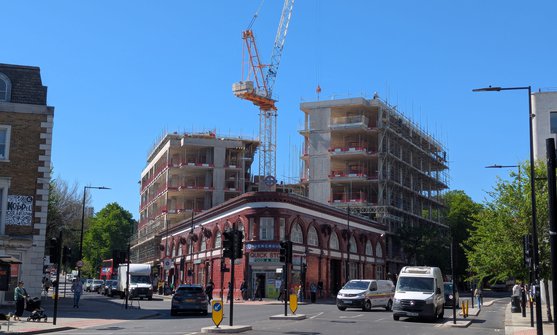
The Belrose - Concrete Frame Complete
Concrete frame now complete at The Belrose, Camden on Haverstock Hill.